
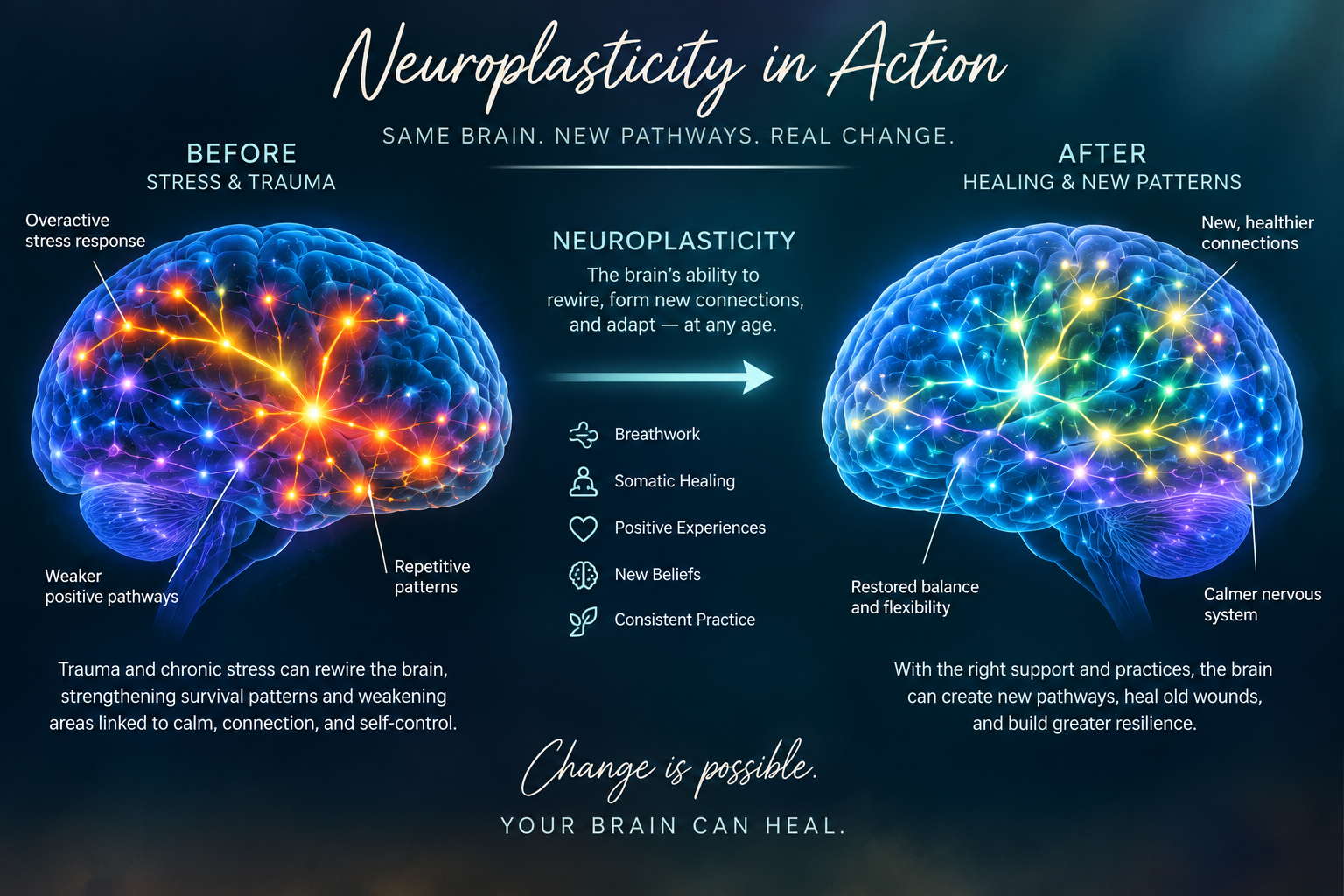
Your Brain Can Change, and That’s Good News
Neuroplasticity means your brain can change. It can form new connections, make some connections stronger, and make others weaker, based on your experiences and what you learn. People used to think the brain stopped changing after childhood. Now we know that the brain keeps the ability to change for your whole life. It changes the most when we are young, but it never fully stops.
So how does the brain change? A lot of it comes down to repetition. What your brain does today shapes what it does tomorrow. This is why habits and reactions can feel automatic. They are paths your brain has used many times. It also means new paths can be built. Change has limits, and it looks different in each part of the brain and at different times in life. It takes practice and patience, but it is possible.
This is where somatic work fits in. Somatic work is about noticing what is happening in your body. Scientists have studied body awareness through mindfulness, a close cousin of somatic practice. They found that mindfulness is linked to changes in parts of the brain that help with body awareness and handling emotions. In one study, mindfulness training made the connections stronger in the insula, a part of the brain that helps you sense what is going on inside your body. In simple terms, paying attention to your body is linked to real changes in the brain.
Being trauma-informed is how I make sure this work feels safe. A trauma-informed approach changes the question from “What’s wrong with you?” to “What happened to you?” It is built on four ideas: realizing how common trauma is, recognizing its signs, responding with trauma-informed principles, and avoiding re-traumatizing .Safety is one of its main principles. Since the brain changes through experience, how the work feels matters. That is why I focus on safety, choice, and going at your own pace when taking any of my groups online.
Sources
- Neural plasticity across the lifespan (review): https://vivo.weill.cornell.edu/display/pubid27911497
- Neuroplasticity development and mechanisms (review): https://sms.carm.es/ricsmur/handle/123456789/26412
- Brain plasticity definition: https://fiveable.me/ap-psych-revised/key-terms/brain-plasticity.md
- Brain plasticity and its limits: https://mtrx.poff.ee/post/brain-plasticity-refers-to-which-of-the-following
- How mindfulness meditation works (Hölzel et al., 2011): https://www.nmr.mgh.harvard.edu/publications/journal_articles/396
- Mindfulness training and the insula (connectome study): https://qigonginstitute.org/abstract-print/14003
- SAMHSA’s guidance on a trauma-informed approach: https://youth.gov/feature-article/samhsas-concept-trauma-and-guidance-trauma-informed-approach
- What is trauma-informed care (SNHU): https://snhu.edu/about-us/newsroom/health/what-is-trauma-informed-care