
The Pause Between the Feeling and the Reaction
The Pause Between the Feeling and the Reaction
By Melanie
For many years, my emotions ran the show. Intense bursts of anger, waves of anxiety, and stretches of numbness were part of my daily life, and it took me decades to find something that helped. Traditional therapy wasn’t that something for me. Retelling my trauma over and over to be analyzed left me feeling worse, not better. That is my experience only, and I know many people have been helped by therapy. What worked for me was different: Affirmations, and later Somatic breathing, shadow work, and NLP. I’m not claiming a cure, but my emotional dysregulation has lessened, and I understand myself far better than I used to. Here is how it happened.
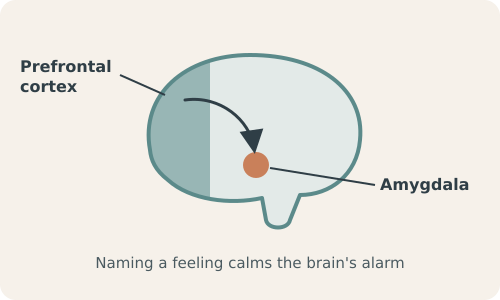
The biggest shift came when I discovered the pause. Just before an emotion bursts out in words or action, there is a sliver of silence, and I learned to get curious inside it. In that moment, I ask myself: Where do I feel this in my body? Where is it coming from? Is it even mine to respond to? Science supports this approach. Researchers have found that simply naming an emotion, known as affect labeling, is associated with less activity in the amygdala, the brain’s alarm system, and more engagement from the prefrontal cortex, the part that helps us regulate (Lieberman et al., 2007). Likewise, noticing physical sensations, called interoception, builds the self-awareness that makes the pause possible (Craig, 2002).
I sometimes ask whether a feeling is inherited or borrowed from someone else. That question is less strange than it sounds, because we learn emotional patterns from the people who raised us, and feelings can be contagious.
The body is where this work becomes real. Somatic breathing helped me release tension I didn’t know I was holding, especially in my face, where I had spent years grinding and clenching. The research points the same way. Slow, controlled breathing has been shown to increase heart rate variability and activate the parasympathetic nervous system, which signals the body to settle out of fight-or-flight (Zaccaro et al., 2018).
Affirmations have research behind them, too. Studies on self-affirmation show that reflecting on your values and worth can activate reward and self-related regions in the brain and soften the stress response (Creswell et al., 2005; Cascio et al., 2016). Neither practice is magic, and neither is for everyone, but both work for me.
Here is what I’ve learned most: we are not our emotions. Please don’t hear that as “smile like the Joker and pretend everything is fine.” We are human, and feelings will come up. What I’m inviting you to do is sit with them, breathe, listen, and then decide how to respond, rather than letting the feeling decide for you. This human body was given to us to care for, and caring for it means learning its language. An emotion rises and falls like a wave, and the pause is where your power lives.
Sources
- Cascio, C. N., O’Donnell, M. B., Tinney, F. J., Lieberman, M. D., Taylor, S. E., Strecher, V. J., & Falk, E. B. (2016). Self-affirmation activates brain systems associated with self-related processing and reward and is reinforced by future orientation. Social Cognitive and Affective Neuroscience, 11(4), 621–629. https://doi.org/10.1093/scan/nsv136
- Craig, A. D. (2002). How do you feel? Interoception: the sense of the physiological condition of the body. Nature Reviews Neuroscience, 3(8), 655–666. https://pubmed.ncbi.nlm.nih.gov/12154366/
- Creswell, J. D., Welch, W. T., Taylor, S. E., Sherman, D. K., Gruenewald, T. L., & Mann, T. (2005). Affirmation of personal values buffers neuroendocrine and psychological stress responses. Psychological Science, 16(11), 846–851. https://sites.lifesci.ucla.edu/psych-taylorlab/wp-content/uploads/sites/5/2014/10/2005_Affirmation-of-Personal-Values-Buffers-Neuroendocrine-and-Psych-Stress-Responses.pdf
- Lieberman, M. D., Eisenberger, N. I., Crockett, M. J., Tom, S. M., Pfeifer, J. H., & Way, B. M. (2007). Putting feelings into words: Affect labeling disrupts amygdala activity in response to affective stimuli. Psychological Science, 18(5), 421–428. https://pubmed.ncbi.nlm.nih.gov/17576282/
- Zaccaro, A., Piarulli, A., Laurino, M., Garbella, E., Menicucci, D., Neri, B., & Gemignani, A. (2018). How breath-control can change your life: A systematic review on psycho-physiological correlates of slow breathing. Frontiers in Human Neuroscience, 12, 353. https://doi.org/10.3389/fnhum.2018.00353